Why Titanium Fights Back During Brazing
Two properties of titanium drive almost every challenge in the brazing shop:
It reacts instantly with oxygen and nitrogen at a temperature. As titanium heats up, it forms a tenacious oxide layer within seconds of exposure to air. That layer blocks the filler metal from wetting the surface, so instead of a clean, well-bonded seam, you get poor flow, voids, and weak joints. This is why titanium brazing almost always demands either a hard vacuum — typically better than 10⁻⁴ Pa — or a high-purity inert atmosphere (99.999% argon or better) to keep oxygen away from the surface.
It conducts heat poorly and melts at a high temperature. Because heat doesn't move through titanium quickly, uneven heating is a constant risk. Localized hot spots can coarsen the grain structure, trigger unwanted phase transformations, or crack the joint outright — a particular concern with two-phase (α+β) alloys like Ti-6Al-4V, which are more microstructurally sensitive than commercially pure titanium.
Put together, these two traits mean that titanium brazing success depends as much on atmosphere and heating control as it does on filler metal selection.
Choosing a Process Route
Vacuum Brazing — the Industry Standard
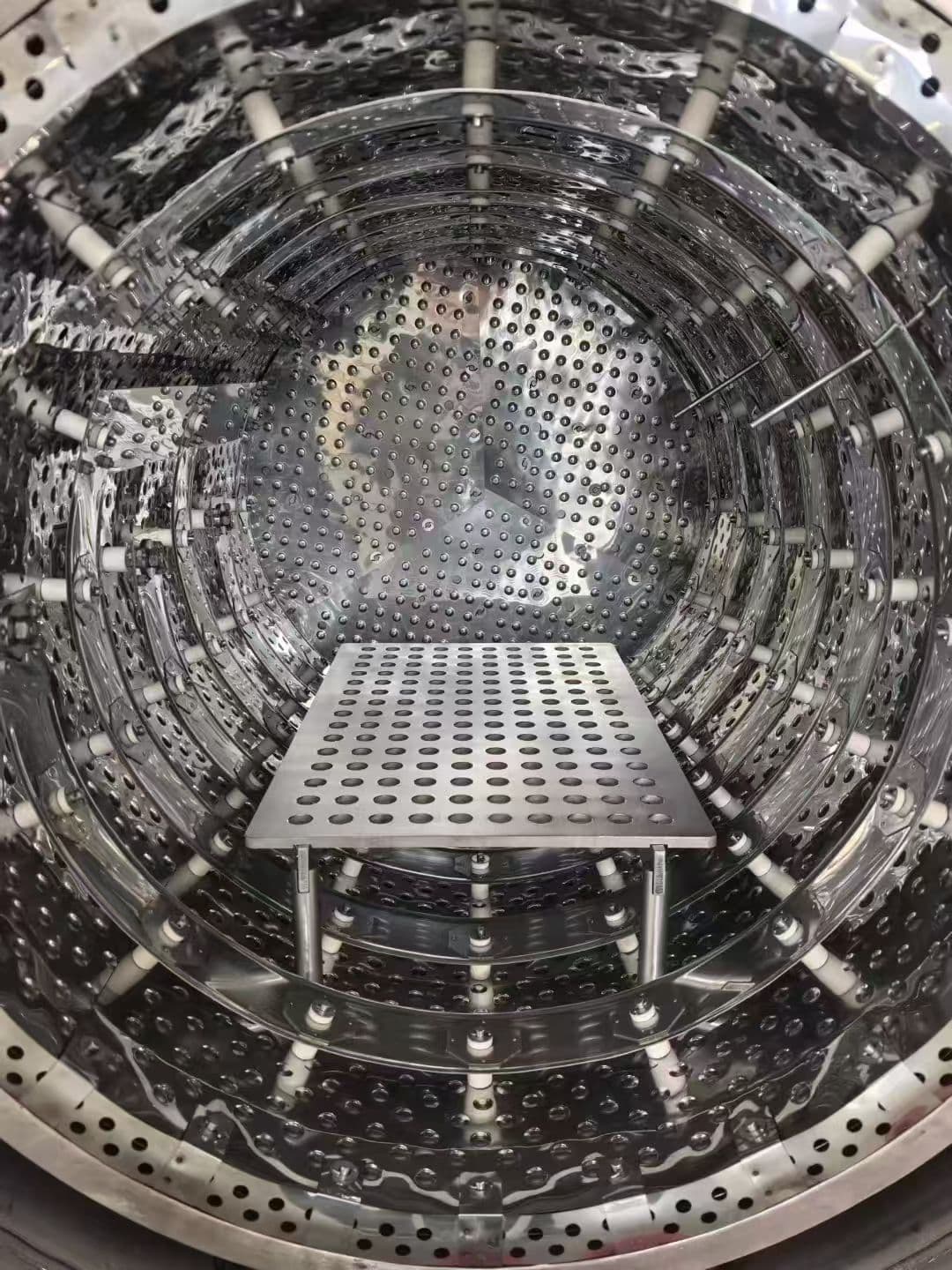
For anything structural, sealed, or destined for aerospace or medical service, vacuum brazing is the default choice. The part and filler metal are heated inside a vacuum furnace, typically to 880–950°C, with chamber pressure held below 10⁻⁴ Pa. At that vacuum level, the native oxide film is suppressed and eventually broken down thermally, allowing the filler metal to wet and flow into the joint without any flux at all.
The payoff is a clean, inclusion-free joint that needs no post-braze cleaning — important when the part is a hydraulic line, an engine cooling component, or anything else where residue simply isn't acceptable. The tradeoffs are the ones you'd expect from any vacuum furnace process: higher capital cost, longer cycle times, and tighter process control requirements. For production volumes and mission-critical parts, though, it remains the most repeatable and trusted method available.
Induction and Flame Brazing — Fast, Flexible, Lower-Cost
When a vacuum furnace isn't available, or the job is a one-off repair or prototype, induction and flame brazing offer a practical alternative. Both rely on localized heating in open air, paired with a titanium-specific flux — most commonly TiBF-19 — to chemically break down the oxide layer at the joint. These fluxes typically work in the 760–815°C range.
Induction heating brings fast, efficient, tightly localized heat input with a small heat-affected zone, while flame brazing offers hands-on flexibility that's hard to beat for field repairs or awkward geometries. The catch is that neither process can fully exclude atmospheric oxygen, so some risk of oxide inclusions and porosity is unavoidable. That makes these methods a good fit for non-structural components, instrument prototypes, or lab samples — but not for parts that will see long-term structural or pressure-bearing service.
Active Brazing — Joining Titanium to Ceramics and Glass
Standard filler metals don't wet ceramic, glass, or quartz surfaces well, which rules out conventional brazing whenever titanium needs to be joined to a non-metal. Active Brazing Alloys (ABAs) solve this by incorporating reactive elements — titanium and zirconium themselves — into the filler metal. At brazing temperature (typically 850–930°C), these elements react chemically with the ceramic surface to form a stable bonding layer, effectively "activating" wetting where it wouldn't otherwise occur. Ti-Zr-Ni-Cu systems are among the most common alloys used this way.
Like vacuum brazing, active brazing depends on a clean atmosphere — high vacuum or high-purity argon — to keep the reactive elements from oxidizing before they can do their job at the interface. Success also hinges on managing thermal expansion mismatch across the metal-ceramic boundary and controlling the thickness of the reaction layer. Done well, this process underpins precision packaging for optical housings, infrared windows, and ceramic sensor enclosures bonded to titanium bases.
Selecting a Filler Metal
Titanium filler metals fall into five broad families, each with its own temperature window and best-fit application:
| Filler Metal Family | Brazing Temperature Range | Best Suited For |
|---|---|---|
| Silver-based | 720–950°C | Dissimilar metal joints (Ti to copper, brass, stainless); heat-sensitive parts |
| Titanium-based | 850–1020°C | Ti-to-Ti or Ti-to-similar-alloy joints needing near-parent-metal strength |
| Aluminum-based | 600–750°C | Low-temperature or auxiliary joints; not for load-bearing service |
| Palladium-based | 1050–1150°C | High-temperature, high-reliability sealing; nuclear and aerospace critical parts |
| Zirconium-based | 790–950°C | Ti-to-stainless, Ti-to-zirconium, and ceramic interfaces needing thermal-stress compatibility |
Silver-based fillers are the go-to when heat input needs to stay low — think heat-sensitive assemblies or medical-grade titanium fittings. They flow well and wet readily when paired with a flux like TiBF-19, but they aren't the right choice for parts that will see sustained high heat or aggressive corrosion.
Titanium-based fillers (commonly Ti-Cu-Ni systems) are the workhorses of high-performance titanium-to-titanium joints. They're built to approach the strength of the parent metal and hold up under heat and corrosion, which is why they show up so often in aerospace heat exchangers and hydraulic systems. They're almost always used flux-free, under vacuum or high-purity argon.
Aluminum-based fillers operate at the lowest temperatures of the group, which sounds appealing but comes with a catch: aluminum wets titanium poorly, and the two elements readily form brittle intermetallic phases at the interface. These fillers are best reserved for non-structural or temporary joints — not anything that will carry a mechanical load in service.
Palladium-based fillers sit at the top of the temperature range and deliver excellent wetting and corrosion resistance, but at a real cost premium. They're reserved for applications where reliability and service life outweigh material cost — nuclear components, high-temperature aerospace hardware, and premium sensor packages.
Zirconium-based fillers benefit from zirconium's close match to titanium in crystal structure and thermal expansion, which helps minimize thermal stress at dissimilar-metal or ceramic interfaces. They perform well in nuclear, chemical processing, and corrosive service environments.
Getting the Flux Right (When You Need One)
Flux exists to do one job: strip the oxide film so the filler metal can actually touch and wet the base metal. Whether you need one — and which kind — depends entirely on your process route.
- Vacuum or high-purity argon with an active or titanium-based filler: No flux needed. The vacuum itself suppresses oxidation, and in active brazing systems the filler's own reactive elements do the surface cleanup.
- Flame or induction brazing in open air: A fluoroborate flux such as TiBF-19 is essential. It actively decomposes the surface oxide and forms a temporary protective barrier against re-oxidation, typically working in the 750–900°C range. Because it leaves residue, thorough post-braze cleaning with hot water or a chemical rinse is mandatory — leftover flux will corrode the joint over time.
- Titanium-to-ceramic or glass joints: Active filler systems (Ti-Zr-Ni type) replace external flux entirely, which is exactly what's needed for zero-residue precision packaging.
- Residue-sensitive applications (medical, aerospace): Vacuum brazing with an active filler metal is the cleanest path. If open-air processing is unavoidable, budget for a rigorous cleaning step afterward.
One flux family worth avoiding entirely: older zinc-chloride-based fluxes. They remove oxide aggressively but are highly corrosive to titanium and difficult to fully clean off, which is why they've largely disappeared from modern practice except in isolated lab settings.
Dialing In the Process Parameters
A handful of parameters make the difference between a strong joint and a failed one:
- Joint gap: Keep it between 0.025 and 0.1 mm. Too tight and capillary flow struggles; too wide and you invite porosity and voids.
- Soak time: Hold at brazing temperature for 5–15 minutes — long enough for full wetting and diffusion, short enough to avoid excessive grain growth in the base metal.
- Heating rate: Stay at or below 10°C per minute. Given titanium's poor thermal conductivity, faster ramps create uneven heat distribution and thermal stress that can warp or crack the part.
- Atmosphere: Maintain vacuum below 10⁻⁴ Pa, or use 99.999%-pure argon if working under inert gas protection. Either is necessary to keep oxidation from undoing everything else you've controlled for.
Defects to Watch For
Even with good process control, a few failure modes show up repeatedly in titanium brazing:
- Oxide inclusions — usually the result of degraded flux activity or vacuum that isn't holding, showing up as dark inclusions in the seam that weaken the joint.
- Incomplete filling — filler metal that doesn't fully wick into the joint by capillary action, often because the gap is too large or the surfaces weren't properly cleaned before brazing.
- Brittle intermetallic phases — a particular risk with dissimilar-metal joints, such as Ti-Fe phases forming with steel or Ti-Al phases forming with aluminum fillers, when temperature or hold time runs too high. Tight control of both variables is the main defense.
Verifying Joint Quality
Non-destructive methods — X-ray, ultrasonic testing, or dye penetrant inspection — are the first line of defense, catching pores, cracks, and inclusions without sacrificing the part. Where higher assurance is needed, destructive testing fills the gap: shear and peel strength tests quantify joint integrity, while metallographic cross-sectioning under a microscope reveals whether wetting was complete and whether any brittle phases formed at the interface.
The Bottom Line
Titanium brazing rewards process discipline. Get the atmosphere, filler metal, and heating profile right, and you can produce joints that rival the strength and cleanliness of the parent material — which is exactly why vacuum brazing remains the standard for aerospace, medical, and other high-reliability titanium components. For lower-volume or field work, induction and flame brazing with the right flux remain viable, provided you understand and accept the tradeoffs in joint cleanliness and long-term reliability.
If you're specifying or sourcing a vacuum furnace for titanium brazing production, the vacuum level, temperature uniformity, and controlled ramp-rate capability of the equipment matter just as much as the filler metal and flux choices covered above — it's worth evaluating furnace performance against these same parameters before committing to a platform.